

Each EB-5 investor must be credited with the creation of at least 10 qualifying U.S. jobs under the EB-5 Immigrant Investor Program. Under current EB-5 regulations, the minimum EB-5 investment amount is $800,000 for projects located in a qualifying targeted employment area (TEA). The Project is located in a Rural TEA and, accordingly, the offering is being structured using the $800,000 minimum investment amount applicable to Rural TEA projects. Based on the Project Investment Plan (PIP) budget and the economic impact analysis, the Project is projected to generate substantially more qualifying jobs than the minimum required, providing an investor job cushion (i.e., the excess of estimated qualifying jobs above the minimum jobs required for the anticipated number of EB-5 investors) intended to be used in connection with EB-5 petition requirements.
The Villa Roma Project will redevelop the resort hotel, serviced apartments, recreational facilities, and common areas, and will construct a new conference center. The resort includes 139 hotel guestrooms and 232 serviced apartments, all of which are expected to be comprehensively refurbished with updated designs and amenities.
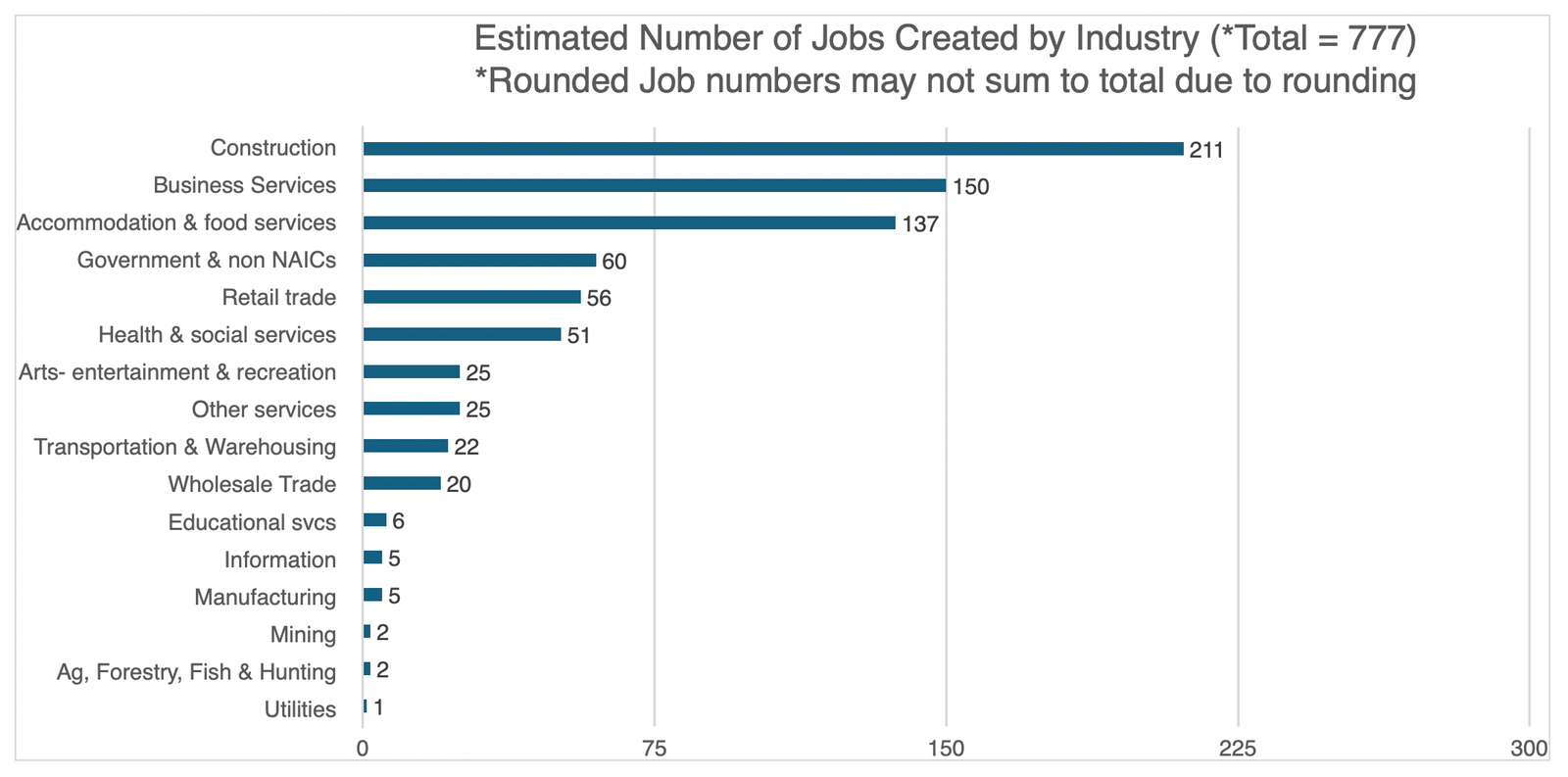
The total employment impact attributable to the Project is estimated at approximately 777 jobs, including approximately 528 jobs associated with redevelopment and construction-related expenditures (direct, indirect, and induced impacts as modeled) and approximately 249 jobs associated with resort operations through the third year. These estimates are intended to be used in connection with the EB-5 job-creation requirement applicable to filings such as Form I-526E and Form I-829, as applicable.
Renovations are currently scheduled to occur from December 2025 through December 2027 (approximately 25 months). The Resort is expected to remain open during the renovation period. The renovation scope involves a comprehensive refurbishment and upgrade, and the associated job creation is expected to be consistent with the refurbishment and upgrade expenditures reflected in the PIP and the economic impact analysis.
EB-5 job creation estimates include direct, indirect (activity generated from intermediate purchases through the industry supply chain), and induced (activity generated from employee household spending) effects of the Project in the local community, using an expenditure-based approach (based on project revenues and/or construction spending), as reflected in the Project’s economic impact analysis prepared for EB-5 purposes.
Because these job-creation projections are expenditure-based, demonstrating that EB-5 capital was deployed and that project expenditures were incurred substantially as described in the Project’s business plan and the applicable EB-5 filing (including Form I-526E, as applicable) is generally an important component of establishing the job-creation basis for EB-5 visa classification, together with satisfaction of any other applicable program requirements.
Maximum Job Creation Potential
Maximum job creation potential for the Project is estimated at approximately 777 jobs.
The Project economist estimates that the development will generate approximately 777 jobs, supporting a maximum EB-5 investment capacity of approximately $61.2 million. To provide an additional margin of safety for EB-5 investors and their petitions, total Project costs have been optimized to $52.1 million.
The New Commercial Enterprise (NCE) is targeting a minimum EB-5 capital raise of $51.2 million, rather than the full $52.1 million Project Investment Plan (PIP) budget, because the remaining portion of the PIP budget has already been contributed by the Sponsor through an equity investment in support of the Project currently underway.
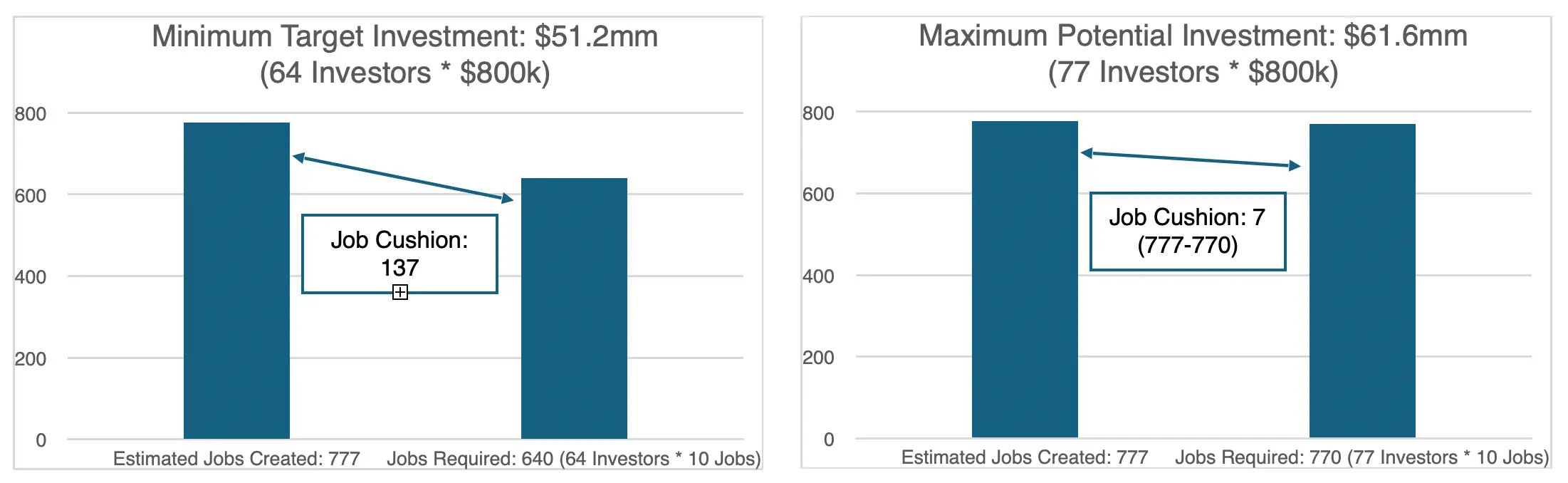
Based on the $51.2 million EB-5 target raise, the offering is expected to support approximately 64 investors (based on the EB-5 requirement of 10 qualifying jobs per investor), resulting in a total job creation requirement of 640 jobs.
With an estimated 777 jobs, the Project provides a per investor job cushion of approximately 21.4% (increased from 19.3% due to the Sponsor’s additional equity contribution), exceeding the minimum job creation threshold required under the EB-5 Immigrant Investor Program.
The majority of job creation is expected to be generated through construction-related expenditures (direct, indirect, and induced impacts as modeled), with additional indirect and induced employment resulting from project-related economic activity and ongoing operations. The PIP’s renovation-focused scope and defined 25+ month construction timeline are expected to support timely and reliable job creation for EB-5 job-creation requirement purposes, intended to be used in connection with filings such as Form I-526E and Form I-829, as applicable.
EB-5 job-creation requirement: 10 qualifying U.S. jobs per EB-5 investor
Project location: Rural TEA project located in Sullivan County, Callicoon, New York (Catskills Region of Upstate New York)
EB-5 minimum investment amount (Rural TEA): $800,000 per investor (compared to $1,050,000 for non-TEA projects under current EB-5 regulations), which may support eligibility for EB-5 visa classification (subject to meeting all applicable program requirements)
Minimum Target (EB-5 capital raise target)
Target investors: 64
Minimum target jobs required: 640 (64 investors × 10 jobs)
Minimum target investment: $51.2 million (64 investors × $800,000)
Project Maximum Capacity (based on estimated job creation)
Estimated total jobs created: 777 (presented as 770 for EB-5 planning purposes)
Maximum investors supported: 77
Maximum investment capacity: $61.6 million (77 investors × $800,000)
Investor Job Cushion (buffer)
If the minimum target is achieved, the estimated job cushion is 137 jobs (777 − 640), representing an estimated 21.4% cushion (137 ÷ 640).
If the maximum capacity is achieved (using 770 jobs for EB-5 planning), the estimated job cushion is 7 jobs (777 − 770), representing an estimated 0.9% cushion (7 ÷ 770).
Minimum Target Investment reflects the EB-5 capital raise and equals the $52.1 million total Project Budget less the portion of Sponsor equity applied toward the Project Budget. The Sponsor has also contributed additional equity and advances to the Project beyond the portion credited toward the Project Budget.
Minimum Target Investment reflects the EB‑5 capital raise. It equals the $52.1 million total Project Budget less the portion of Sponsor equity applied toward the Project Budget. The Sponsor has also contributed additional equity and advances to the Project beyond the portion credited toward the Project Budget.
The Project’s regional study area includes Sullivan, Orange, Ulster, and Delaware Counties and captures approximately 91% of workers traveling to Sullivan County. Total workforce employment in the regional study area is estimated at approximately 348,583 jobs, with an estimated Gross Regional Product (GRP) of $31.50 billion.
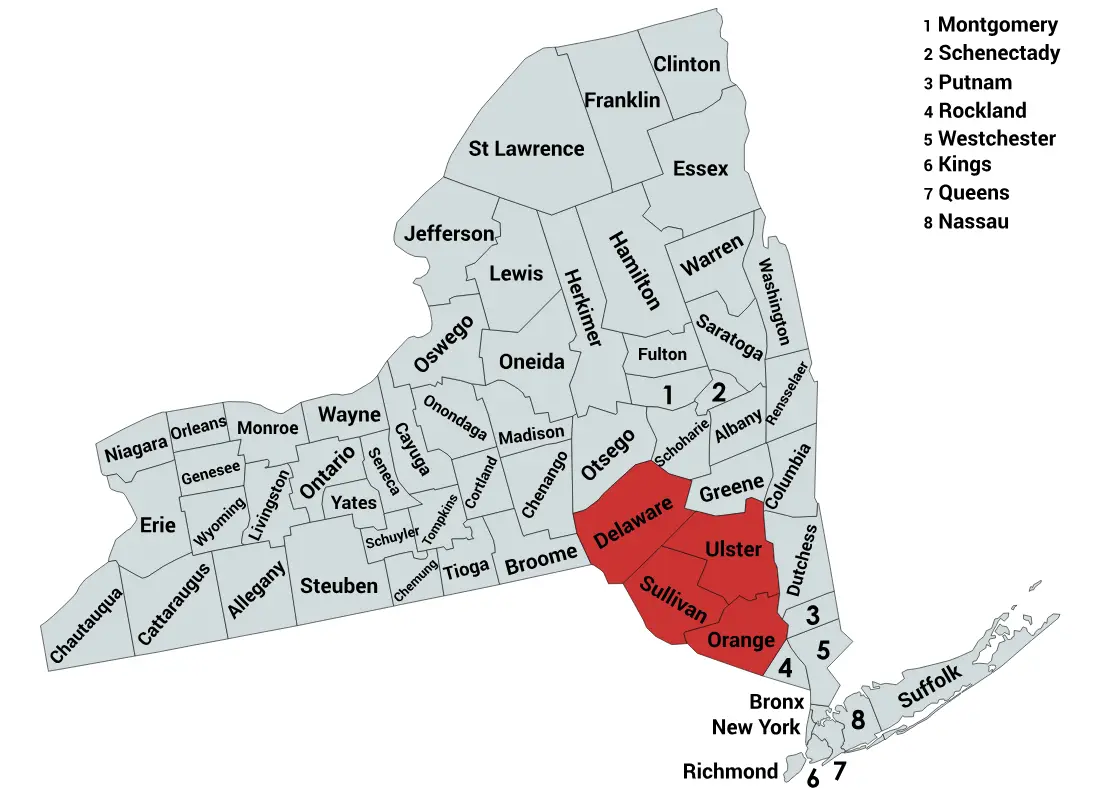
Source: MapChart
| State | County Name | Workers in Commuting Flow | Cumulative % |
| New York | Sullivan County | 21,603 | 79.62% |
| New York | Orange County | 1,706 | 85.90% |
| New York | Ulster County | 846 | 89.02% |
| New York | Delaware County | 502 | 90.87% |
Source: U.S. Census Bureau, Census county-to-county worker flows, averages for 2016-20.
Qualifying Targeted Employment Area (TEA)
A Targeted Employment Area (TEA) is defined under federal law as an area with an unemployment rate of at least 1.5 times the national average for the applicable reference period, or a rural area (outside a metropolitan statistical area and outside the boundary of any city or town having a population of 20,000 or more).
The Project location qualifies as a Rural TEA because Sullivan County, New York is not part of a metropolitan statistical area and is outside the boundary of any city or town with a population of 20,000 or more. As a result, the Project is being structured as a Rural TEA EB-5 offering using the $800,000 minimum investment amount under the EB-5 Immigrant Investor Program (subject to meeting all applicable program requirements).
The economic impact analysis summarizes the estimated economic impacts associated with the development and operations of the Villa Roma Resort in Sullivan County, Callicoon, New York (Catskills Region of Upstate New York), within the Project study area. This analysis is intended to be used in connection with EB-5 visa job-creation documentation and related EB-5 investor materials, consistent with applicable program requirements.
| Activity | Impact Type | Employment (Jobs) | Labor Income | Value Added | Output |
|---|---|---|---|---|---|
| Development | Direct Effect | 232 | $13,354,375 | $18,713,918 | $44,719,550 |
| Indirect Effect | 80 | $4,147,253 | $7,827,022 | $14,931,877 | |
| Induced Effect | 215 | $12,595,531 | $21,073,151 | $32,708,063 | |
| Total Effect | 528 | $30,097,159 | $47,614,091 | $92,359,490 | |
| Operating Revenues | Direct Effect | 146 | $3,912,896 | $8,831,306 | $14,074,246 |
| Indirect Effect | 17 | $818,789 | $1,432,132 | $3,005,264 | |
| Induced Effect | 86 | $5,278,383 | $8,504,443 | $12,902,379 | |
| Total Effect | 249 | $10,010,067 | $18,767,881 | $29,981,889 | |
| Total (Development + Operations) | 777 | $40,107,226 | $66,381,972 | $122,341,379 | |