
EB-5 Visa Pathway

Villa Roma is an EB-5 project located in a qualifying Rural Targeted Employment Area (TEA). This page provides a high-level overview of the EB-5 visa pathway and typical immigration steps under the EB-5 Immigrant Investor Program. Any eligibility for U.S. lawful permanent residence (a “green card”) is subject to investor eligibility, satisfaction of all applicable EB-5 requirements, and USCIS adjudication. (No outcome or processing timeframe is guaranteed).

EB-5 in One View

The EB-5 program (the EB-5 Immigrant Investor Program) allows eligible foreign investors to make a qualifying investment in a U.S. project that is intended to create jobs. If all program requirements are met, an investor may apply for U.S. lawful permanent residence for the investor, the investor’s spouse, and unmarried children under 21.

EB-5 generally involves:
Investment in a qualifying U.S. project. An investor contributes the required EB-5 capital amount (for this Project, $800,000 as a Rural TEA investment), plus applicable fees as described in the offering documents.
Job creation. Each EB-5 investor must be credited with at least 10 qualifying U.S. jobs under the EB-5 Immigrant Investor Program. For Villa Roma, job creation is projected based on construction-related expenditures and operations associated with the Property Improvement Plan (PIP), as reflected in the project’s economic impact analysis.
Conditional permanent residence first. Eligible EB-5 investors typically seek conditional U.S. lawful permanent resident status (generally via Form I-526E) initially and later file to remove conditions (Form I-829). If the applicable filings are approved by USCIS (and a visa is available) and all EB-5 requirements are satisfied, the investor may obtain unconditional U.S. lawful permanent resident status (green card). 

USCIS is the U.S. government agency that administers and adjudicates EB-5-related filings.

  • EB-5 = Investment–based immigration. Investors place capital into a qualifying U.S. project that creates at least 10 full-time jobs.
  • Family benefit. One qualifying EB-5 investment can support a green card application for the investor, their spouse and unmarried children under 21.
  • Project-based job creation. For Villa Roma, jobs are created through the construction and operation of the Project Improvement Plan (PIP).
  • Conditional green card first. Successful investors typically receive a conditional 2-year green card before applying to remove conditions.

The EB-5 program is administered by U.S. Citizenship and Immigration Services (USCIS).

EB-5 structure diagram

Why Rural TEA Status Matters (Villa Roma)

Villa Roma is located in a Rural TEA, which may offer EB-5 program advantages compared to non-TEA projects, subject to USCIS rules and procedures and subject to change by law or policy.

Investment Amount (Rural TEA)
$800,000 Minimum Investment Amount (Rural TEA)
Under current EB-5 regulations, the minimum EB-5 investment amount for a qualifying Rural TEA project is $800,000 (compared to $1,050,000 for non-TEA projects). Minimum investment amounts may change.
Processing (Priority Processing)
Priority Processing (Where Available)
Certain Rural TEA petitions may be eligible for priority processing where available and as determined by USCIS. Processing times vary by case and are subject to change.
Investor Job Cushion
Rural TEA projects often emphasize job creation planning and an “investor job cushion” (estimated jobs above the minimum required). Villa Roma’s job creation and job cushion metrics are presented on the Job Creation page and are based on the project’s economic impact analysis. Rural TEA benefits are established by U.S. law and policy and may change over time.

Rural TEA benefits are established by U.S. law and policy and can change over time.

Step-by-Step EB-5 Immigration Journey

Below is a simplified view of a typical EB-5 process. Your actual process may vary depending on your personal circumstances, country of chargeability, and USCIS procedures. Investors should consult qualified immigration counsel.

STEP 1
Preparation
Investor completes questionnaires, reviews offering documents, and executes the subscription package.
STEP 2
Funding
Investor wires the EB-5 investment amount to the NCE account and pays the administrative fee, as described in the offering documents.
STEP 3
Form I-526E Filed
Immigration counsel files Form I-526E. Once filed, the investor generally receives a priority date.
STEP 4
Conditional Lawful Permanent Residence
If USCIS approves the required filings and a visa is available, the investor and eligible family members may obtain conditional lawful permanent resident status (through consular processing or adjustment of status, as applicable).
STEP 5
Sustainment Period / Job Creation
The EB-5 investment must remain invested and “at risk” during the applicable EB-5 sustainment period, while the project implements the PIP and job creation is expected to occur as projected.
STEP 6
Form I-829 (Removal of Conditions)
Immigration counsel files Form I-829 to remove conditions, subject to meeting applicable program requirements. If approved, the investor may obtain unconditional U.S. lawful permanent resident status (green card).

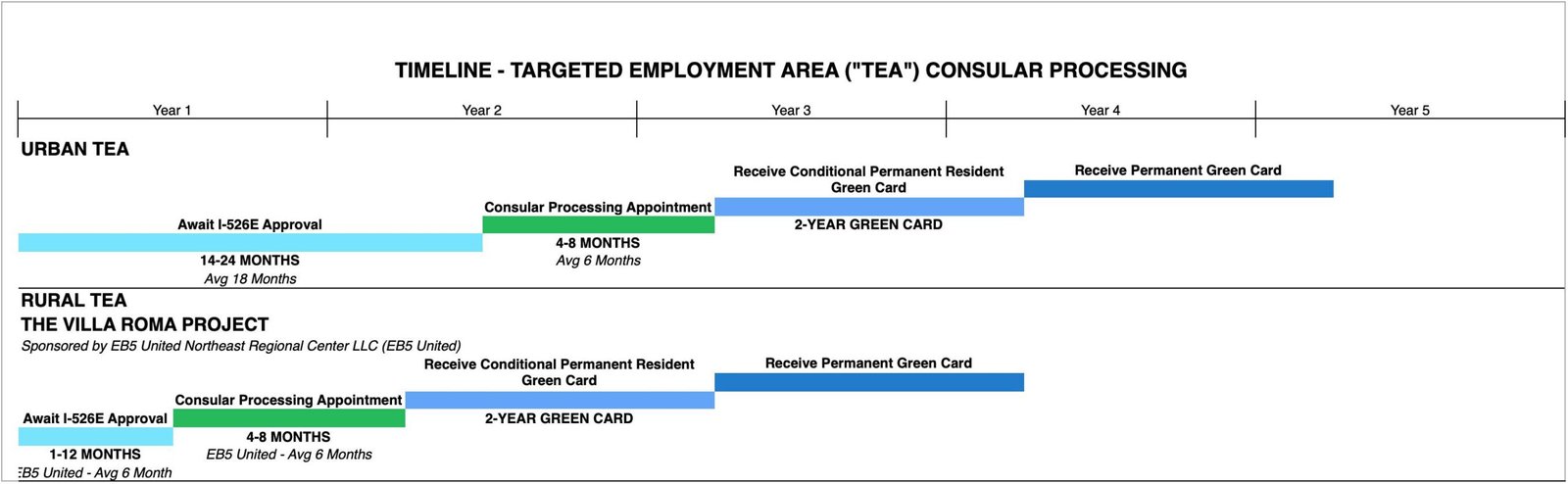
Villa Roma EB-5 Project Pathway Timeline

This timeline is a general overview for educational purposes only; actual timing varies by investor and is subject to USCIS processing, visa availability, and other factors.

The Villa Roma Project – Steps to EB-5 Green Card


1

Subscribe and Invest

Subscribe through the EB-5 portal and complete funding, subject to acceptance of the subscription.

2

USCIS Filings (As Applicable)

Form I-526E is filed by immigration counsel. For investors residing in the United States, Forms I-485 (adjustment of status), I-765 (work authorization), and I-131 (travel authorization) may be filed concurrently with Form I-526E where permitted and appropriate, based on counsel’s advice and USCIS rules.

3

Receipt Notices

USCIS typically issues receipt notices after submission; timing varies.

4

EB-5 Capital Deployment / Job Creation

After applicable release conditions are satisfied, the NCE deploys EB-5 capital into the project, and job creation is expected to occur through PIP implementation and operations, as modeled.

5

I-526E Approval

TEA Rural project approval is approx. 8 months - EB-5 United affiliated Rural projects are seeing approval within an average of 5 months.

6

Conditional Green Card Issued Valid for 2 Years

For Investors Residing Outside the U.S. Consular Processing & Conditional Green Card takes approx. 6-12 months (TEA Rural Projects offer priority processing). For Investors Residing Within the U.S. Adjustment of Status & Conditional Green Card approval typically comes a few months after I-526E Approval, dependent on whether or not concurrent Filing occurred.

7

Start of 2 Year Conditional Residency - Job Creation Sustainment Period.

8

I-829 Removal of Conditions

21 months after Conditional Green Card issued, file form I-829. Processing times vary. Upon approval, permanent green card issued.

Who Can Apply Under EB-5?

The EB-5 program is open to qualified investors from around the world who can make a qualifying investment and meet the immigration requirements.

Basic Investor Profile

The EB-5 program is available to eligible investors worldwide who can make a qualifying investment and satisfy EB-5 requirements, including:

  • Ability to invest the required EB-5 amount (currently $800,000 for a qualifying Rural TEA project), plus fees.
  • Lawful source of funds (e.g., business income, salary, sale of property), documented in accordance with EB-5 requirements.
  • Willingness to keep funds invested and “at risk” for the required period.
  • No disqualifying criminal or immigration issues under U.S. law.